Saturday, September 27, 2008

Los hijos cargarán con los pecados de los padres

ESPAÑOL 301

Se me ocurre que quizá les sea útil meditar en lo siguiente antes o después de de leer "No oyes ladrar los perros" de Juan Rulfo.

Un tipo de carga:
Do the sons bear the sins of the fathers or not?: Exodus 20:5, Deuteronomy 5:9 and Deuteronomy 24:16; Ezekiel 18:20
1. YES they do
1. (Exodus 20:5) - "You shall not worship them or serve them; for I, the Lord your God, am a jealous God, visiting the iniquity of the fathers on the children, on the third and the fourth generations of those who hate Me,"
2. (Deuteronomy 5:9) - "You shall not worship them or serve them; for I, the Lord your God, am a jealous God, visiting the iniquity of the fathers on the children, and on the third and the fourth generations of those who hate Me,"
3. (Exodus 34:6-7) - "Then the Lord passed by in front of him and proclaimed, "The Lord, the Lord God, compassionate and gracious, slow to anger, and abounding in lovingkindness and truth; 7who keeps lovingkindness for thousands, who forgives iniquity, transgression and sin; yet He will by no means leave the guilty unpunished, visiting the iniquity of fathers on the children and on the grandchildren to the third and fourth generations."
4. (1 Cor. 15:22) - "For as in Adam all die, so also in Christ all shall be made alive."
2. NO they don't
1. (Deuteronomy 24:16) - "Fathers shall not be put to death for their sons, nor shall sons be put to death for their fathers; everyone shall be put to death for his own sin."
2. (Ezekiel 18:20) - "The person who sins will die. The son will not bear the punishment for the father’s iniquity, nor will the father bear the punishment for the son’s iniquity; the righteousness of the righteous will be upon himself, and the wickedness of the wicked will be upon himself."

Otro tipo de carga:
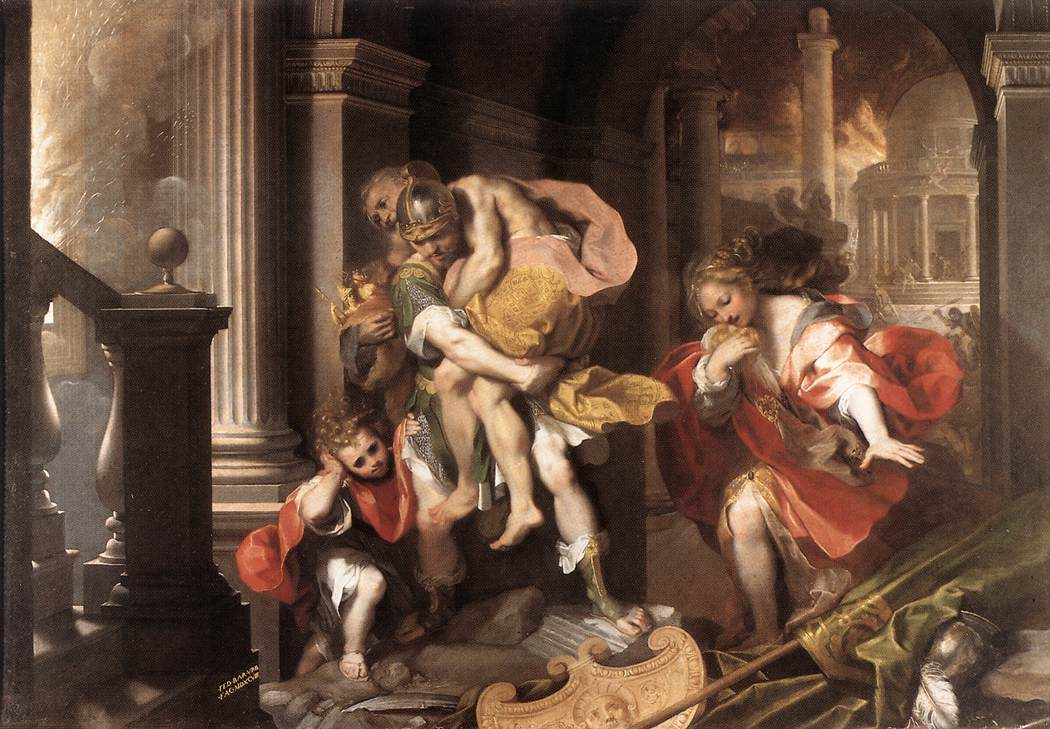
Aeneas was the son of Anchises and Venus. He was a cousin of King Priam of Troy, and was the leader of Troy's Dardanian allies during the Trojan War. After the fall of Troy, he led a band of Trojan refugees to Italy and became the founder of Roman culture (although not of the city of Rome itself). He was the mythical progenitor of the Julian gens through his son Ascanius, or "Iulus," and Virgil made him the hero of his epic, the Aeneid.

See Aeneas - Aeneas, Anchises, and Ascanius Fleeing Troy, 1596, by Federico Barocci, Galleria Borghese, Rome
See Aeneas - Aeneas, Anchises, and Ascanius, 1619, by Bernini, Galleria Borghese, Rome
See Aeneas - Aeneas carrying Anchises, Ascanius, and Creusa out of Troy ["Fire in the Borgo"], by Raphael and assistants 1511-1515

Psychoanalysis and Feminism: Sarah Palin & Judith Warner

FL 200

This morning I came across the following blog entry on Sarah Palin by NYT contributor Judith Warner. The post tells how Warner's reading of a photograph of Sarah Palin and elder statesman and Jewish cultural icon, Henry Kissinger, leads her to feel sympathy for the former. The feeling prompts her to compare Palin and Elle Woods, the ditzy, gutsy, hardw0rking, and ultimately brilliant heroine of the Legally Blond and Legally Blond II movies. Faulty as this analogy is, the post and the comments readers made on it are a very interesting read.
Warner's analysis falls somewhere between Cultural Studies, Psychoanalytical criticism and Feminism. It raises as many questions about Palin and John McCain as it does about Warner and her take on contemporary American women. Have fun with it!

Thursday, September 25, 2008

3 tesis, 3 párrafos y 3 opciones para tus ensayos

SPAN 301

Como todos sabemos, escribir ensayos críticos no es tan fácil como parece. No solamente es necesario interrogar los textos y luchar para encontrar un buen tema, también hay que esforzarse para crear una tesis estimulante que le haga justicia al tema.
Como ejemplo de lo anterior y en preparación para su próximo texto crítico, les presento tres "primeros párrafos" sobre La rosa de Anderson Imbert. Estúdienlos y traten de entender cómo funcionan.

PÁRRAFO NO. 1
La rosa de Enrique Anderson Imbert, presenta un espectáculo desolador tras la devastación de una pobre aldea por soldados enemigos. De en medio del desastre surge la posibilidad de restitución o venganza cuando una nueva Judith aparece para hacerle frente al Holofernes cuyas tropas casi violan a su pobre y vieja abuela. Sin embargo, el texto subvierte nuestras expectativas. La rosa roja que antes ha servido para humillar a la anciana pasa a los pechos de la coqueta moza que optará por “hacer el amor y no la guerra”. El recuerdo bíblico es solo eso, una desvirtuada leyenda sobre la que Judith salta como antes ha hecho con el cadáver de la vieja que salva su vida.

Este ensayo parte de la idea de que La rosa es una re-interpretación de una historia bíblica: el fatal encuentro entre la heroica Judith y el torpe y lascivo gigante Holofernes.

PÁRRAFO NO. 2
Si el mito cristiano del origen de la humanidad castiga a la primera mujer y la condena a la reprobación eterna por sucumbir a la tentación del mal y a su vez seducir a su incauta pareja, La rosa de Anderson Imbert parece abrir una puerta a la consolación. La expulsión del paraíso, la tentación carnal y la seducción aparecen en este cuento libres de toda censura moralizante. Judith, la joven que al final del cuento busca con una flor en los pechos al capitán de la tropa que ha diezmado su aldea no lo hace como la bíblica Judith para descabezarlo sino para hacerlo perder la cabeza por sus tentadores encantos. Así como el desliz de Eva conduce a la verdadera población del mundo tras la abolición del falso paraíso en el cual Jehová y la Serpiente luchan, la unión entre la víctima y el guerrero conquistador se presenta como la única opción lógica en un universo moderno, quizá más cínico pero no menos cruel.


Este ensayo parte de la intuición que tuvimos sobre la correspondencia de la rosa de "Anderson Imbert" y la manzana de George Preedy. Se trataría de un ensayo que ve en La rosa un comentario acérbico sobre el mito de la creación.

PÁRRAFO NO. 3
Todo texto, como advierte la crítica post-estructuralista, se constituye en relación con otros textos. En algunos casos incluso se puede decir, como habría afirmado Borges, que todo texto es la re-escritura de un texto anterior. No hay ejemplo más claro que La rosa de Enrique Anderson Imbert. Presentado al lector como una carta en la que un anónimo autor re-escribe un cuento de George R. Preedy, la historia que se cuenta en La rosa es a su vez una re-escritura de una popular historia bíblica. El mítico gigante Holofernes se enfrenta otra vez en el cuento de Anderson Imbert a una imponente Judith. Sin embargo, como veremos, se trata esta vez de un combate de otro tipo. Al igual que la inconclusa carta del anónimo autor, el narrador de esta re-escritura bíblica opta por un final abierto que pone en tela de juicio la autoridad de la historia original.

Este ensayo está más interesado en leer el texto de Anderson Imbert como re-escritura. Lo que le interesa al autor es acentuar su carácter post-moderno. Se trata de un fragmento de un mito dentro de un fragmento de otro texto: la anónima carta a George R. Preedy.

Tuesday, September 23, 2008

My Brain on Crack

FL 200

It occurs to me that this provocative and poignant list hits on some of the issues we talked about when we analyzed Governor Palin's press release concerning the pregnancy of her teenage daughter. It further helps understand the kind of cultural criticism that "reading against the grain" allows you to make. Enjoy it, even if it makes you feel weird.

This Is Your Nation on White Privilege

September, 14 2008
By Tim Wise

For those who still can't grasp the concept of white privilege, or who are constantly looking for some easy-to-understand examples of it, perhaps this list will help.

* White privilege is when you can get pregnant at seventeen like Bristol Palin and everyone is quick to insist that your life and that of your family is a personal matter, and that no one has a right to judge you or your parents, because "every family has challenges," even s black and Latino families with similar "challenges" are regularly typified as irresponsible, pathological and arbiters of social decay.
* White privilege is when you can call yourself a "fuckin' redneck," like Bristol Palin's boyfriend does, and talk about how if anyone messes with you, you'll "kick their fuckin' ass," and talk about how you like to "shoot shit" for fun, and still be viewed as a responsible, all-American boy (and a great son-in-law to be) rather than a thug.
* White privilege is when you can attend four different colleges in six years like Sarah Palin did (one of which you basically failed out of, then returned to after making up some coursework at a community college), and no one questions your intelligence or commitment to achievement, whereas a person of color who did this would be viewed as unfit for college, and probably someone who only got in the first place because of affirmative action.
* White privilege is when you can claim that being mayor of a town smaller than most medium-sized colleges, and then Governor of a state with about the same number of people as the lower fifth of the island of Manhattan, makes you ready to potentially be president, and people don’t all piss on themselves with laughter, while being a black U.S. Senator, two-term state Senator, and constitutional law scholar, means you’re "untested."
* White privilege is being able to say that you support the words "under God" in the pledge of allegiance because "if it was good enough for the founding fathers, it's good enough for me," and not be immediately disqualified from holding office--since, after all, the pledge was written in the late 1800s and the "under God" part wasn't added until the 1950s--while believing that reading accused criminals and terrorists their rights (because, ya know, the Constitution, which you used to teach at a prestigious law school requires it), is a dangerous and silly idea only supported by mushy liberals.
* White privilege is being able to be a gun enthusiast and not make people immediately scared of you. White privilege is being able to have a husband who was a member of an extremist political party that wants your state to secede from the Union, and whose motto was “Alaska first," and no one questions your patriotism or that of your family, while if you're black and your spouse merely fails to come to a 9/11 memorial so she can be home with her kids on the first day of school, people immediately think she's being disrespectful.
* White privilege is being able to make fun of community organizers and the work they do--like, among other things, fight for the right of women to vote, or for civil rights, or the 8-hour workday, or an end to child labor--and people think you're being pithy and tough, but if you merely question the experience of a small town mayor and 18-month governor with no foreign policy expertise beyond a class she took in college--you're somehow being mean, or even sexist.
* White privilege is being able to convince white women who don’t even agree with you on any substantive issue to vote for you and your running mate anyway, because all of a sudden your presence on the ticket has inspired confidence in these same white women, and made them give your party a "second look."
* White privilege is being able to fire people who didn't support your political campaigns and not be accused of abusing your power or being a typical politician who engages in favoritism, while being black and merely knowing some folks from the old-line political machines in Chicago mean you must be corrupt.
* White privilege is being able to attend churches over the years whose pastors say that people who voted for John Kerry or merely criticize George W. Bush are going to hell, and that the U.S. is an explicitly Christian nation and the job of Christians is to bring Christian theological principles into government, and who bring in speakers who say the conflict in the Middle East is God's punishment on Jews for rejecting Jesus, and everyone can still think you're just a good church-going Christian, but if you're black and friends with a black pastor who has noted (as have Colin Powell and the U.S. Department of Defense) that terrorist attacks are often the result of U.S. foreign policy and who talks about the history of racism and its effect on black people; you're an extremist who probably hates America.
* White privilege is not knowing what the Bush Doctrine is when asked by a reporter, and then people get angry at the reporter for asking you such a "trick question," while being black and merely refusing to give one-word answers to the queries of Bill O'Reilly means you're dodging the question, or trying to seem overly intellectual and nuanced.
* White privilege is being able to claim your experience as a POW has anything at all to do with your fitness for president, while being black and experiencing racism is, as Sarah Palin has referred to it, a “light" burden.
* And finally, white privilege is the only thing that could possibly allow someone to become president when he has voted with George W. Bush 90 percent of the time, even as unemployment is skyrocketing, people are losing their homes, inflation is rising, and the U.S. is increasingly isolated from world opinion, just because white voters aren't sure about that whole "change" thing. Ya know, it’s just too vague and ill-defined, unlike, say, four more years of the same, which is very concrete and certain.

White privilege is, in short, the problem.

Tim Wise is the author of White Like Me (Soft Skull, 2005, revised 2008), and of Speaking Treason Fluently, publishing this month, also by Soft Skull. For review copies or interview requests, please reply to publicity@softskull.com

Sunday, September 21, 2008

Why Theory? / ¿Teoría para qué?

FL 200 & ESPAÑOL 301

This question is one that comes up every year I teach either of these courses. Even students who get into theory wonder at times if it has any other usefulness besides making reading literature a highly challenging proposition.

Here then is a challenge to you: Identify theoretical paradigms at work in this article.

The text in question is not literary criticism but political analysis. Its author is not a professor or a theorist with a French name but an American journalist from the New York Times.

A little bit about him: "Nicholas D. Kristof writes op-ed columns that appear twice each week in The New York Times. A two-time Pulitzer Prize winner, he previously was associate managing editor of The Times, responsible for the Sunday Times" NYT. Oh, and to top it of he is from Yamhill, Oregon.

Saturday, September 20, 2008

Cardinal Newman, Father Ambrose St. John, and Oscar Wilde

FL 200

The following two news items and (1 & 3) and the single biographical entry on Oscar Wilde (2) should help us see the extent to which what "happens" inside Dorian Gray's old schoolroom, that is, what is reflected on Basil Hallward's supernatural canvas is still something that troubles the good Christian people of England.

(1) Violating Cardinal Newman's wishes The Pope wants to rebury John Newman separately from the man he loved, Father Ambrose St John [09/04/2008]

(2) "[Oscar] Wilde defeated Edward Carson for the foundation scholarship in classics at Trinity College, Dublin, and in 1874 won a scholarship to Magdalen College, Oxford, where he was influenced by John Ruskin, Walter Pater and Cardinal Newman. He became a disciple of aestheticism, pursuing beauty for beauty's sake; his poem Ravenna (1878) won the Newdigate Prize" [Wilde's biographical sketch]

(3) "Fr. Ian Ker [sic], a priest and biographer of Cardinal Newman, told the Weekend Australian yesterday that homosexulists [sic] were using Newman's close friendship with another priest as a political ploy. 'Clearly' Fr. Kerr said, Newman 'did love his dear friend' but he called it 'ridiculous' to claim, a century after the fact, that they were homosexuals who lived 'as husband and wife.' 'There is no evidence for that whatsoever, and everything he wrote and said suggests he would have thought homosexuality was immoral, not to mention that it was illegal at the time. Theirs was a close friendship that some people are now trying to misrepresent and use for their own purposes'" [09/04/2008]

Sometimes, current events render what we read more dramatic. This is one of those moments.

Friday, September 19, 2008

Postmodernism

FL 200

On Thursday we will be discussing chapter 4 of Barry's book on Literary Theory. That is, we will be talking about postmodernism. Names such as Jürgen Habermas, François Lyotard, and Jean Baudrillard are on the agenda.

Postmodernism is the name of a category and postmodernity is the label applied to the times we currently live in. These names would seem to indicate that we have broken with modernity, yet nothing could be less accurate. Culture works on a principle of accretion. If we are still fairly medieval about a number of things, married to many Renaissance notions, baroque at times, solid defenders of rationalism and other enlightened positions, romantics to the core, etc., it is no less the case that modernism is very much with us today and within postmodernism. Aesthetic currents such as Cubism, Dadaism, Surrealism, and Futurism are still in some form alive today. "In some form" is the operational term here.

In a nutshell, the relationship between modernism and postmodernism is akin to that between our attitudes towards love at different points in our life. Thus, after having had one's heart broken by the first time our take on love resembles modernism. Yet, after very many sad, happy, joyful, and deep relationships with many wonderful lovers we tend to be closer to postmodernism. There is no drama in postmodernism and no regrets. Playfulness is central. A gentle irony pervades it all. There is no "romance of my life", as Dorian would have put it, and that is just perfectly fine. Being together with someone has ceased to be about great verities such as LOVE, MARRIAGE, FAMILY, etc. and has become self-referential: relationships are all about themselves. Etc.

Below you will find some basic principles, courtesy of Professor Mary Anne Gillies. Also do make sure to study Professor's Klages handout on postmodernism available here and in Moodle. It will make Barry's short chapter much more meaningful.

POSTMODERNISM: Label given to Cultural forms since the 1960s that display the following qualities:

  • Self reflexivity: this involves the seemingly paradoxical combination of self-consciousness and some sort of historical grounding
  • Irony: Post modernism uses irony as a primary mode of expression, but it also abuses, installs, and subverts conventions and usually negotiates contradictions through irony
  • Boundaries: Post modernism challenges the boundaries between genres, art forms, theory and art, high art and the mass media
  • Constructs: Post modernism is actively involved in examining the constructs society creates including, but not exclusively, the following:
  1. Nation: Post modernism examines the construction of nations/nationality and questions such constructions
  2. Gender: Post modernism reassesses gender, the construction of gender, and the role of gender in cultural formations
  3. Race: Post modernism questions and reassesses constructs of race
  4. Sexuality: Post modernism questions and reassesses constructs of sexuality